
Some of God’s worst enemies are those who claim to honor and worship Him. Christians who distort the character of God by teaching traditions rather than biblical truth are no different than the scribes and Pharisees in the Gospels. These religious teachers thought they were the true people of God, but Jesus called them sons of their father, the devil. They taught as truth the traditions of men.
Jesus said to them, “Woe to you, scribes and Pharisees, you hypocrites! You shut the kingdom of heaven in men’s faces. You yourselves do not enter, nor will you let in those who wish to enter. Woe to you, scribes and Pharisees, you hypocrites! You traverse land and sea to win a single convert, and when he becomes one, you make him twice as much a son of hell as you are” (Matt. 23:13-15).
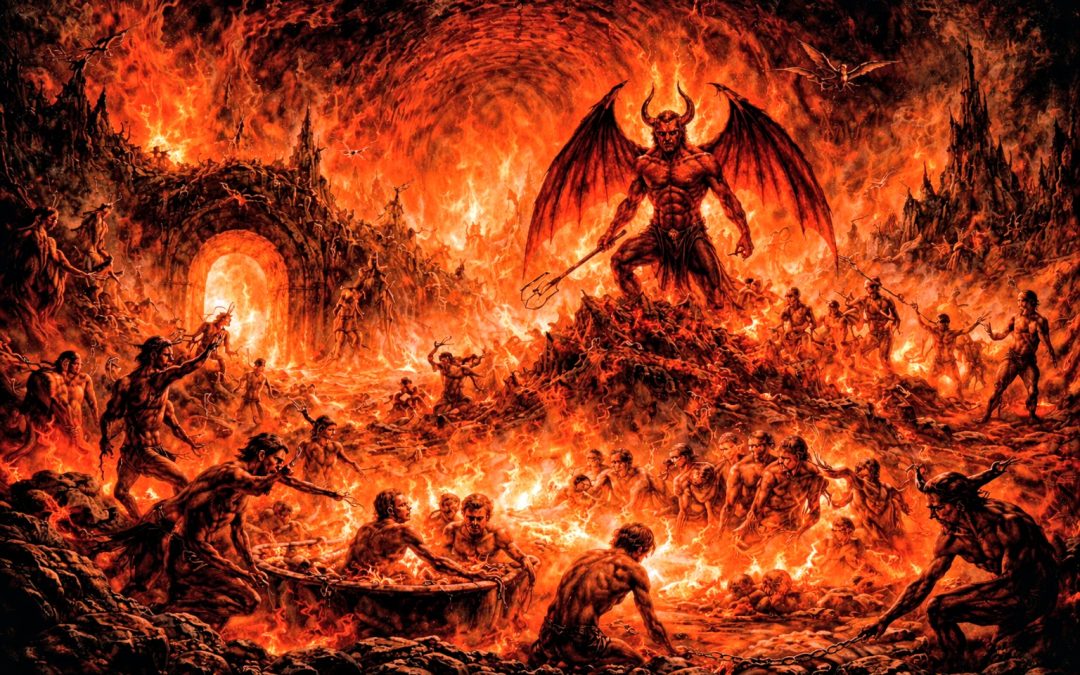
One particularly awful tradition is the doctrine of hell as taught, defended, and fervently believed by millions of Christians today. This doctrine disgusts multitudes who reject a god who would punish His enemies by burning them in conscious torment forever and ever.
And traditional hell is no small part of Christian teaching. It’s actually been a recent point of argument among evangelical Christians. Kirk Cameron is an American actor who at some point in his career not only converted to evangelical Christianity, but became an actual evangelist. He currently hosts a YouTube podcast called The Kirk Cameron Show. On December 3, 2025, he had a podcast conversation with his son James concerning the doctrine of hell.
The outcome of the conversation was indicative of the antichristian nature of many of today’s Christian leaders. Kirk and his son concluded that the traditional understanding of hell, as eternal conscious torment, was a false doctrine. Instead, they proposed annihilationism, the idea that while the lost do suffer divine punishment, or hell, the biblical hell ends in eternal destruction/death, not eternal conscious torment.
The reaction from other noteworthy Christian podcasters was swift. Kirk became an instant object of scorn and accusation. Clearly, Kirk was a heretic, according to many. It seems that the overwhelming majority of Christians today really value the doctrine of an eternally burning hell in which sinners suffer endlessly.
In reality, traditional hell is nothing more than a medieval superstition of the Roman Catholic system.
The ancient Hebrews knew nothing of traditional Christianity’s understanding of hell. King Solomon says, “Whatever you find to do with your hands, do it with all your might, for in Sheol [the grave], where you are going, there is no work or planning of knowledge or wisdom” (Ecc. 9:10).
In the New Testament, Peter uses the story of Sodom and Gomorrah to warn about the fate of the false teachers of his day. They would no more be spared than those two wicked cities, which were reduced to ashes (see 2 Pet. 2:6). According to Moses, “the LORD rained down sulfur and fire on Sodom and Gomorrah (Gen. 19:24). Jude 7 called this judgment “the punishment of eternal fire.”
Of course, we know that the fires of Sodom and Gomorrah are long gone. The cities were turned to ash. The Bible uses the words “eternal” and “everlasting” to describe events of various lengths, depending on the subject. Eternal fire and eternal punishment are the ultimate fate of the wicked, but since the wicked are mortal, they cannot suffer any longer than they have life. The wicked are destroyed, and this destruction will last forever.
After the first century of the Christian era, when pagan Rome gradually gave way to Christian Rome, many pagan ideas were incorporated into the Church. Especially influential were the ancient Greeks, including Plato. From them came the idea of immortal souls and consciousness after death. It was thought that if souls are immortal, then the fires of hell must be immortal as well.
It was St. Augustine (354 AD-430 AD) who finally ended all debate within the Church over the fate of the wicked when he argued for the view of hell most Christians hold today, eternal conscious torment in everlasting fire. The authority for this teaching comes from him, not the Bible.
For many centuries, the Church held this pagan understanding of hell over the heads of the people, using the teaching of an eternally burning hell as a cudgel to intimidate them into thinking twice about ignoring the supposed owner of the keys to the kingdom of heaven, the Church herself.
Most Christians today, especially their pastors and priests, want to maintain the doctrine of eternal conscious torment no matter what. Why? Because it’s orthodox, it’s traditional. And tradition and orthodoxy are not to be questioned. What is the result? Blasphemy against the true character of God.
I want to briefly discuss the traditional doctrine of hell. I can’t be remotely comprehensive, but I can help you see the great danger of traditional hell for humanity’s view of God. Traditional hell makes God look terrible. Can a God who burns his enemies in eternal fire be worthy of our love and worship?
(A fine book to learn more about the doctrine of hell is The Fire That Consumes: A Biblical and Historical Study of the Doctrine of Final Punishment, 3rd edition, Edward Fudge, 2011. This book was mentioned by Kirk Cameron in his podcast.)
First, consider this thought experiment: Would you really be happy in heaven if you knew that somewhere in the universe a kitten was furiously jumping around on a hot grill trying to escape? I myself couldn’t bear to know that. I would set out at once to end that kitten’s misery! And so would you.
Of course, the traditional doctrine of hell involves far more than a single kitten. The vast majority of Christians believe that there are millions of human beings in hell at this moment, some of whom they know personally, writhing in perpetual torment.
And heaven? God and the angels know all of these sufferers much more intimately than any of us and clearly perceive their agonies. Yet, they do nothing!
Here’s the truth. The idea of eternal conscious torment comes from the fertile imagination of the great enemy of God, the devil, not the God of the Bible.
Consider this: Did not Jesus suffer the punishment of the wicked? Did He not plead to have this cup of suffering taken from Him? Yes, He did. But He submitted Himself to the will of His Father for my salvation and yours.
We have to ask, then, what is the punishment of the wicked? According to the Bible, it is eternal death, eternal separation from God. Jesus must have experienced that separation if He indeed suffered the punishment of the wicked. In order to save mankind, Jesus willingly gave up connection to His Father, eternally as far as He knew.
Matthew 27:46 records some of the last words of Jesus on the cross. In His last agonies He cried out, “My God, My God, why have you forsaken Me?” And according to Scripture, Jesus did not receive any assurance that God had not forsaken Him. He died the death of every lost individual, an eternal death. Jesus went to hell in place of every human being.
If this is true, we have to ask a second question. Where is Jesus now? Scripture says He rose from the dead and sits at the right hand of the Father. He is not sitting in flames of woe. He doesn’t have to because sitting eternally in flames of woe is not the fate of the wicked. God’s punishment is not about torture, it is about abandonment of the finally impenitent.
Divine punishment concerns perfect justice. The true doctrine of hell demonstrates the character of God. God hates sin in a way humans will never understand. Those who refuse to reject sin are identifying themselves with sin. And when the end comes, and all warnings of coming judgment are ignored for the last time, all destinies are forever fixed. God will then destroy sin and those who cling to it. This punishment is called “hell.”
Of course, many people believe that any punishment at all makes God look bad, but this view does as much harm to the character of God as does belief in an eternally burning hell!
Humans are sinners. They willingly break God’s law, a law meant to provide safety from the results of evil.
Rejection of God’s law is the cause of all suffering we see in today’s world. A just God would not let this situation last forever. He doesn’t want forever sin. Sin has a way of debasing humanity into darker and darker forms of evil. If sin were not brought to an ultimate end, the world would eventually become completely evil.
This is why God destroyed the world during the Genesis Flood. Scripture says, “Then the LORD saw that the wickedness of man was great upon the earth, and that every inclination of the thoughts of his heart was altogether evil all the time” (Gen. 6:5). God was not being arbitrary and unfair. The world brought punishment upon itself.
We might ask ourselves about the tragedy of World War II. Upwards of 100 million people died in that greatest of all conflicts. Some think it was wrong for the United States to drop the atomic bomb on Japan, but we have to ask, who was to blame for the terrible destruction brought by nuclear weapons? Did the United States unjustly destroy two Japanese cities, or did the Japanese government bring this horror upon their own people? It could be argued that the Japanese destroyed themselves.
If humans are faced with such moral choices, how much more the Creator of heaven and earth?
It would have been unjust for God to do nothing about the evil of the world before the flood. God was not stopping the fun of sin, but the suffering of sinners. Noah preached for 120 years about the coming destruction. All who believed his message could have been easily saved, simply by taking advantage of the ark. Noah could have built two arks, or a hundred! Tragically, no one but his immediate family believed his message of salvation. The flood came and swept the earth clean.
In our day, the same message is being preached. Jesus is coming again, soon, to end the reign of evil and save His people. This is why the last book of the Bible, Revelation, contains the dire warnings of Revelation 14. The third message contains the symbolic language of eternal torment that Catholicism has turned into the traditional doctrine of hell.
Traditional hell has created millions of atheists. Biblical hell comprehends the true nature of divine punishment, that it is a self-imposed loss of eternal life. No one needs to be lost, especially since Jesus has taken on this punishment for each one of us, in our place.
May you find safety in the sacrifice of Christ, given freely for your salvation. God does not torture. God saves. He is the God who can be loved because of who He is. God is love.
Marcus Sheffield here. Babylon Uncovered is my personal ministry. I am not financially supported by any organization. All expenses are mine. Costs are low, but my advertising budget is limited to ten dollars a day on Facebook. Results have been excellent. Posts are getting thousands of likes. If you would like to donate to my advertising expenses, you may do so safely through PayPal. So far I’ve received nearly $300.00. This allowed me to double advertising to twenty dollars a day.