
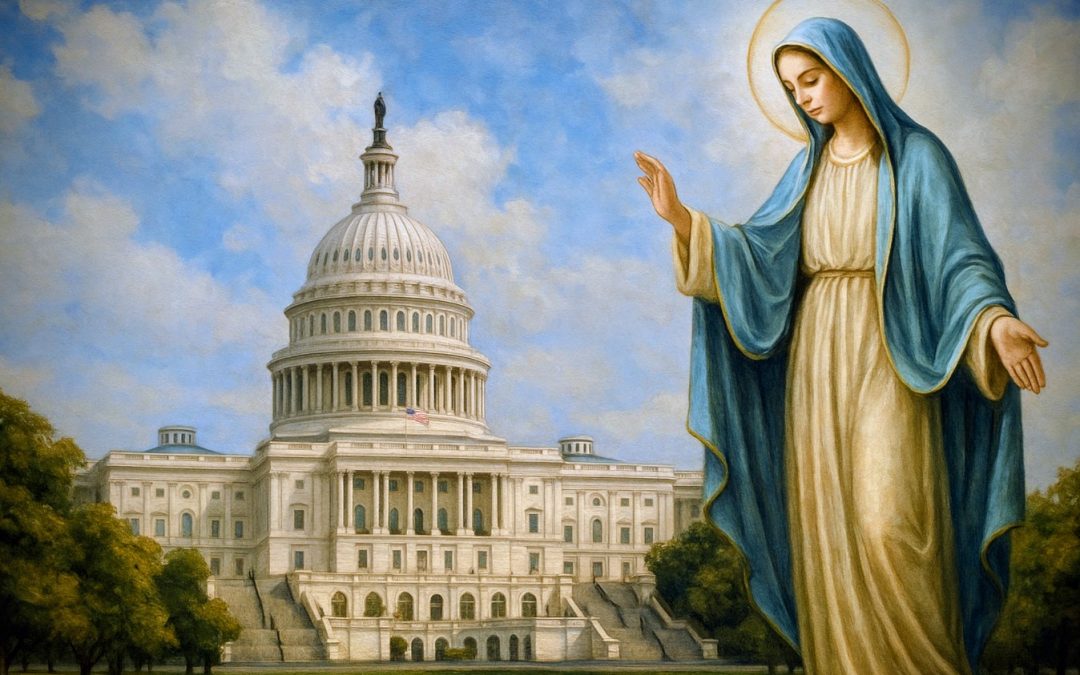
Catholicism has worked diligently since Vatican II creating closer bonds with other Christians as well as with leaders of various non-Christian faiths.
Recent developments show more signs of success in the United States. The recent proclamation by the U.S. government of an All Saints Day message to the nation marked yet another turning point toward religious unity. America has been seen as a bastion of Protestantism. Yet the message showed a considerable tilt toward overturning that historic trait.
Mark Silk of Religious News Service (Nov. 10, 2025), calls the message “one of the most remarkable religious pronouncements” he had ever seen. The All Saints Day message “[celebrated] the saints who have gone before us and now share in the glory of God.”
The Virgin Mary is the official Patroness of the United States of America and is the “symbol of grace for our country.” The message mentions three recently canonized American saints, Frances Xavier Cabrini, Elizabeth Ann Seton, and John Neumann, individuals particularly noteworthy for showing that “faith transforms nations as surely as it transforms hearts.”
Back in 1847, Pope Pius IX approved the U.S. Catholic Bishops’ decision to declare, in so many words, that America was the “Land of Mary Immaculate.”
Silk comments that “All in all, it’s hard to imagine a . . . message more Catholic than this.” Silk adds, “It’s never been done before, so far as I can tell.”
The proclamation was meant to “[ensure] that Christian values maintain their rightful place at the center of American life” (emphasis supplied). Such language parallels that used by religious pollsters; for example: “The federal government should advocate Christian values.” According to Pew Research Center, 44% of Americans approve of this statement.
These facts should be a warning to the nation. The blueprint for planned changes in the United States government advocates a national Sunday law for the benefit of workers.
The United States last debated a national Sunday law in 1888. Senator Henry Blair proposed a law enforcing Sunday as a national day of rest.
Many faithful Christians have never been told about the origin of Sunday observance. Ministers and priests make their arguments for Sunday, but careful study of the Bible shows no support for Sunday sacredness. In the Bible, Sunday is always called the “first day” of the week. The reason for this is simple: the Book of Genesis uses numerals for the days of creation.
When God rested from the six days of creation, the next day was another numeral, the seventh. The word Sabbath comes from what God did on the Sabbath—He rested.
The Hebrew noun shabbat comes from the verb shavat, which means “to cease,” “to stop,” “to rest.” The names we use today come from pagan sources and reflect the names of pagan gods and celestial bodies. Sunday is the day of the Roman Sun god.
Consequently, Sunday, the first day of the week, cannot contain the Hebrew idea of resting. God chose to stop His work; many Christians still choose to stop their work and receive a Sabbath blessing. The blessing of the Sabbath is why God commands it—for our good. Jesus said, “The Sabbath was made for man, not man for the Sabbath. Therefore, the Son of Man is Lord even of the Sabbath” (Mark 2:27-28).
Back in 1888 there was considerable resistance to the “Blair Bill” from those who valued the biblical day of rest. Consequently, the bill failed to pass.
However, the America of 1888 was vastly different from the America of today. There was much prejudice against Catholics back in the late 1800s, as well as prejudice against the immigrants who brought Catholicism with them—mostly the Irish, Germans, Poles, Italians, Czechs, and French Canadians.
Today, these prejudices are mostly gone, and Catholicism is the single largest denomination in the country. Protestants make up 40% of the population, but they are divided into denominations smaller than Roman Catholicism.
Many prominent Americans are now members of the Catholic faith, including the Vice President of the United States, as well as six of nine justices of the Supreme Court. The so-called WASPs (White Anglo-Saxon Protestants) no longer dominate public life as they once did as late as the 1960s.
Attitudes have dramatically changed, as has Protestant theology. The vast majority of Protestants now see Catholics as “brothers in the faith” and view the Pope as one of the greatest moral leaders in the world. This is a far cry from when the papacy was considered the Antichrist.
Ecumenism has triumphed. Americans today seek unity in matters of faith and downplay differences of belief. In fact, most people today, even Christians, are post-modern moral relativists. Knowledge of the Bible is weak, and much Christian worship emphasizes emotion and experience over doctrinal niceties.
According to Maurice DuBois of CBS Evening News, Americans are moving into nondenominational churches not tied to larger institutions. The country now has some 40,000 nondenominational churches, which account for 14% of the American population, a tremendous surge from 1972, with only 3% (online, Nov. 17, 2025).
Denominations are usually tied to detailed statements of faith. The nondenominational churches, by contrast, are not. They claim the Bible as their foundation but rarely engage in disputes over the meaning of biblical texts. They emphasize a relationship with Jesus. Division over specifics is unwanted.
Thus, the movement for Sunday legislation, if pursued this time around, would likely have much weaker opposition. Sunday sacredness is one article of faith that unifies the Christian world. In addition, the labor movement, Christian or not, would enthusiastically approve of an official day of rest. Other nations with foundations in non-Christian religions already treat Sunday as kind of de facto day off.
Only groups on the fringes of Christianity would be affected by a national Sunday law—denominations such as the Church of God (Seventh Day), Seventh-day Baptists, and Seventh-day Adventists.
A national Sunday law would violate the principle of the separation of church and state. The majority faith would undoubtedly become antagonistic toward religious minorities. Sabbath keepers would become heretics and lawbreakers, worthy of persecution and punishment. It has happened before!
Persecution of religious minorities was common in pagan and papal Rome, as well as in Protestantism. Puritans failed to understand freedom of conscience in the New World. For instance, the Puritans came to America for religious liberty, but only for themselves! And the Roman Church certainly never tolerated Saturday-Sabbath after the Council of Laodicea in 363-364 A.D. At that time, the Church forbade the observance of the seventh-day Sabbath.
The great Puritan Roger Williams (1603-1683) would have no doubt been executed or banished had he not escaped and founded Rhode Island. Williams rejected the enforcement of the first table of the Ten Commandments (commandments 1-4) by the American Puritans. Such enforcement is exactly what Christian nationalists want right now should they achieve the power to do so.
Dissenters would eventually be punished for “false worship” and civil disobedience. The United States would become a Christian tyranny rather than a refuge for dissent, as it has been for 250 years.
Just such persecution is foretold in the Book of Revelation, chapter 13. A symbolic beast, or political/religious power, arises sometime after the death of the Apostle John (the author of Revelation). This church/state power would reign for a figurative 42 months, or 1260 figurative days. At the end of this period, the beast would receive a “mortal wound.” Only the Roman Church fits this time scale.
History indicates that the Bible’s predictions were accurate. In 533 A.D., Emperor Justinian officially recognized the Bishop of Rome as the “head of all the holy churches.” Justinian’s general, Belisarius, ended the Gothic siege of Rome in 538 A.D. At that point, the Bishop of Rome was free to exercise complete control over the city. Papal Rome was born.
If 1260 days/years are added to 538, we arrive at 1798. Did anything religiously significant happen that year? Yes, indeed! That very year Napoleon abolished the Papal States, took Pope Pius VI prisoner, and exiled him to France. This was the “mortal wound” of the Church, a fact admitted even by The Catholic Encyclopedia.
However, Rev. 13:3 indicates that the mortal wound will be healed, and that the whole world will subsequently follow the beast.
The healing of the wound was aided by another beast (political power), which would arise about the time of the wounding of the first beast. No other power fits the description of the second beast as perfectly as does the United States of America.
The United States rose in 1776 and was at first a gentle, lamb-like nation. The Scriptures predict, however, that this nation will eventually become a deceptive religious power that makes an image of the first beast and commands the whole world to worship that image.
The United States is a Protestant nation practicing religious liberty and the separation of church and state. But at some point, America will reject these liberties and become a persecuting power united with Rome. What seemed impossible one hundred years ago is now a distinct possibility.
Current events certainly suggest that the Sunday movement is continuing to gather power. The Bible does not indicate the exact dates of final events, but the Bible certainly predicts very specific final events. If we know what the Scripture predicts, we can recognize events for what they are, whenever they occur.
We must remain dedicated to Bible study and prayer for spiritual wisdom and discernment. A great deception is coming, and we must be ready to defend the truth and resist human and demonic forces.
The Book of John details three defenses for you in these last days. First, get your mind right! John 7:17 says, “If anyone desires to do His will, he will know whether My teaching is from God or whether I speak on My own.” Determine to do God’s will. Second, cling to the Word of God. John 8:31-32 says, “If you continue in My word, you are truly my disciples. Then you will know the truth, and the truth will set you free.” Third, submit to and obey the expressed will of God, no matter the apparent evidence leading in a different direction. The divine promise is clear. God will accomplish in you what you allow Him to. John 17:17 says, “Sanctify them by your truth; Your word is truth.”
I pray that you will prepare now for events that, according to Scripture, lie ahead. There is truth, there is falsehood, and there is choice.
If you desire eternal salvation, follow the admonition of the apostle Peter: “Therefore, brothers, strive to make your calling and election sure. For if you practice these things, you will never stumble, and you will receive a lavish reception into the eternal kingdom of our Lord and Savior Jesus Christ” (I Pet. 1:10-11). Amen!
If you benefit from these articles, please consider visiting BabylonUncovered.com. All content is freely available. Every article is written by Mark Sheffield. Sheffield earned a Ph.D. degree in English from Michigan State University in 1993 and taught composition and literature, including biblical literature, for thirty years at the university level. This site is not affiliated with any church or ministry. The views expressed are those of Mark Sheffield.